The Reminder You Stopped Seeing
Day one, I set a reminder: "Stretch, 10 minutes." It popped up at 07:00 and I stretched. Day two, I stretched. Day three, I tapped it away and told myself I would do it after coffee.
By the second week, the reminder still came every morning. I just did not see it anymore. My thumb closed it before my brain read it.
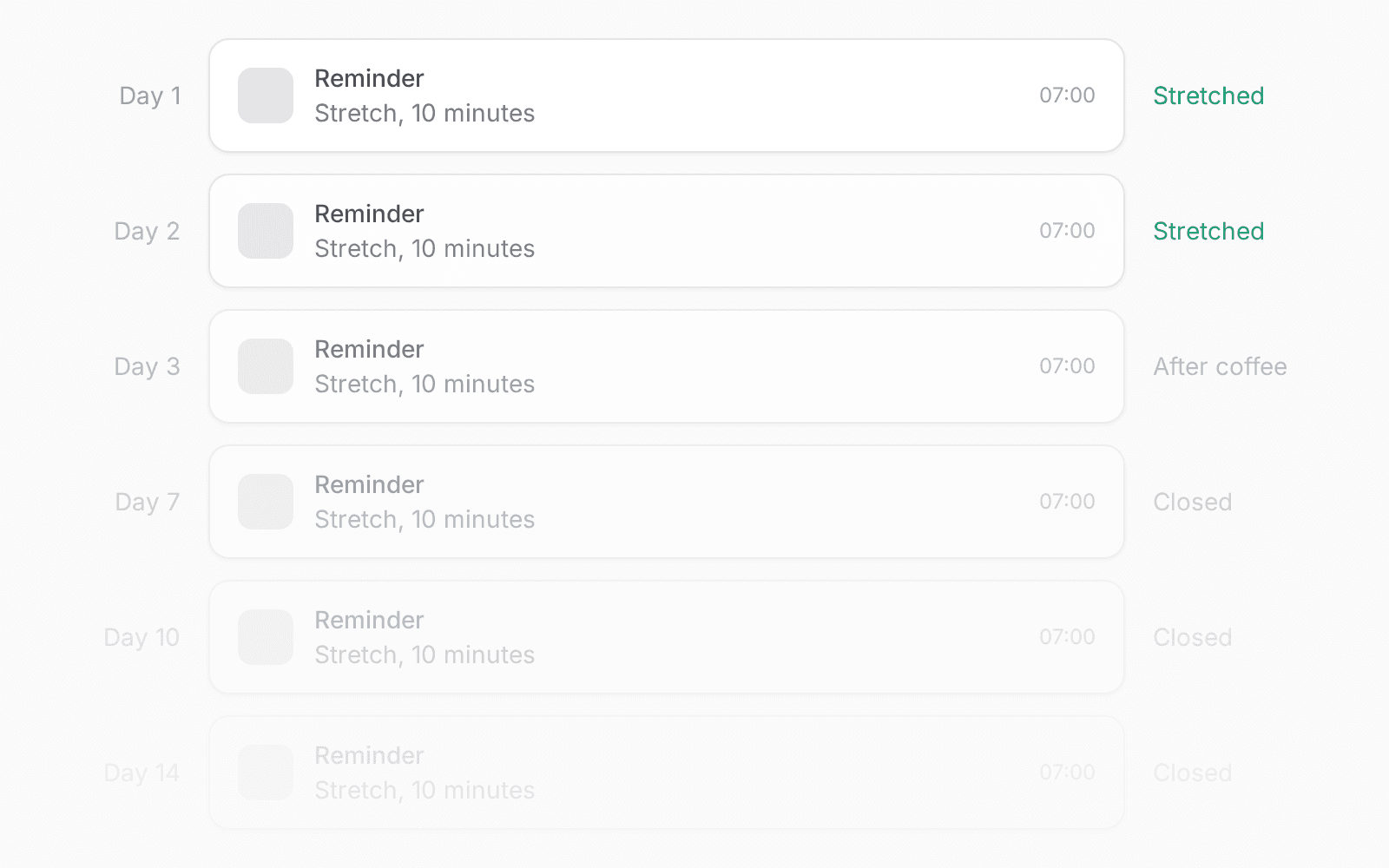
Your brain is doing its job
This has a name: habituation. When the same signal comes again and again, and nothing new happens, the brain learns to stop reacting to it. It is the reason you stop hearing the fridge hum. It is a useful filter. It is also why the hundredth reminder does less than the first.
Researchers at Brigham Young University watched it happen. In a 2018 study, Vance and his team showed people the same security warning many times, with a brain scanner, eye tracking and a field test. Brain response to the warning dropped after only a few views, and it kept dropping in the days after.
Hospitals see the same thing. Doctors get so many computer alerts that they close most of them without reading. A 2017 study by Ancker and colleagues found that each time an alert came again for the same patient, doctors were less likely to act on it. They call it alert fatigue.
Why it hits harder with ADHD
Habituation happens to everyone. But with ADHD, attention already runs on interest. Something new or a little surprising gets in. Something boring and familiar slides off. Many of us know this from our own history of apps: a new habit tracker works great for a week, then it becomes one more icon we do not open.
So the problem is not that you are bad at reminders. The problem is that most reminders look exactly the same every time. Same grey box, same sound, same words. They are built to become invisible.
What keeps a warning visible
The same research team tried a fix. Instead of one fixed warning, they made warnings that change how they look each time: a different colour, a different layout, a little motion. They call these polymorphic warnings. People habituated to them much less. The brain kept treating them as new.
Two things helped:
- It is not the same picture every time. A change in look makes the brain check again.
- The change means something. A signal that changes with the situation is worth reading, so you keep reading it.
One face for each habit
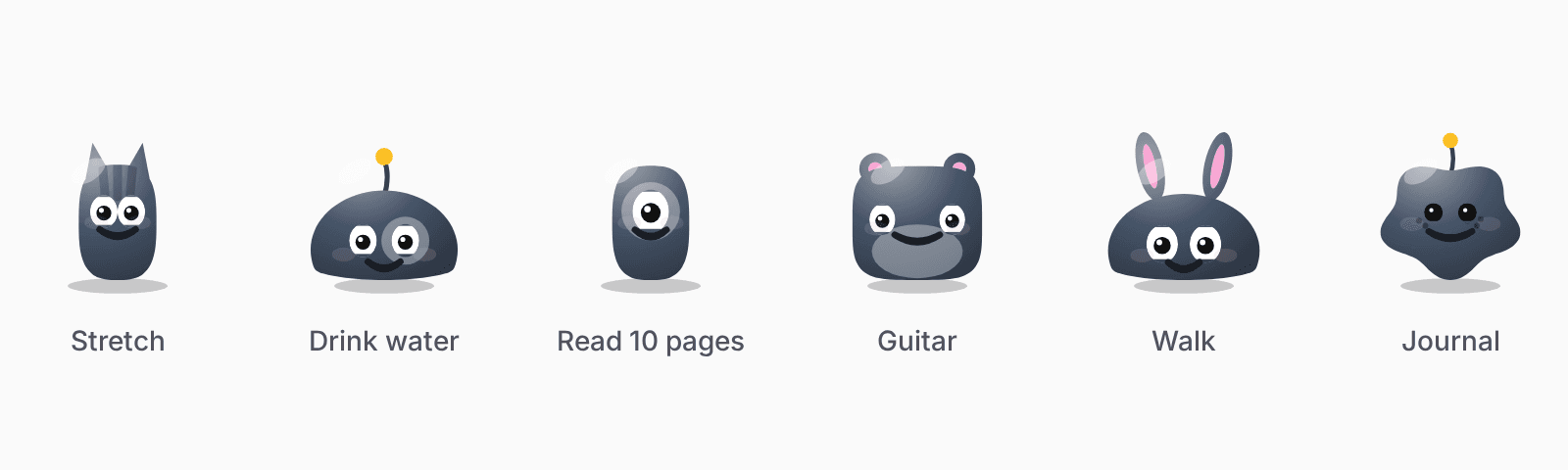
This is why, in Clarity, every habit has its own little face, and no two are the same.
Each face is built from a few parts: a body (a ball, a mochi, a box, a ghost, a cloud, and more), something on top (cat ears, bunny ears, a sprout, horns, a bow, or nothing), a set of eyes, and a marking like spots, stripes or freckles. Together that is more than 2,500 different faces. Your stretch habit gets one. Your water habit gets another. When two faces are on the screen together, the app makes sure they never look alike.
The face belongs to the habit, not to its name. Rename "Stretch" to "Morning stretch" and it is still the same little friend. After a while, you know it by its shape before you read a word.
Its mood changes, so it says something new
The face is also not the same picture from minute to minute. When the habit is due, the face shows up in the corner of your screen, and it waits:
- At first it is calm.
- After 5 minutes it turns orange and annoyed.
- After 10 minutes it is red and angry.
- After 15 minutes it is dark red, furious, with steam coming out.
- Do the habit, and it turns green and proud.
It also moves. It wobbles a little, it blinks at random, and its eyes follow your mouse. These are small things, but they are exactly what a grey banner does not have. A banner you can learn to skip. Something that looks at you is harder to skip.
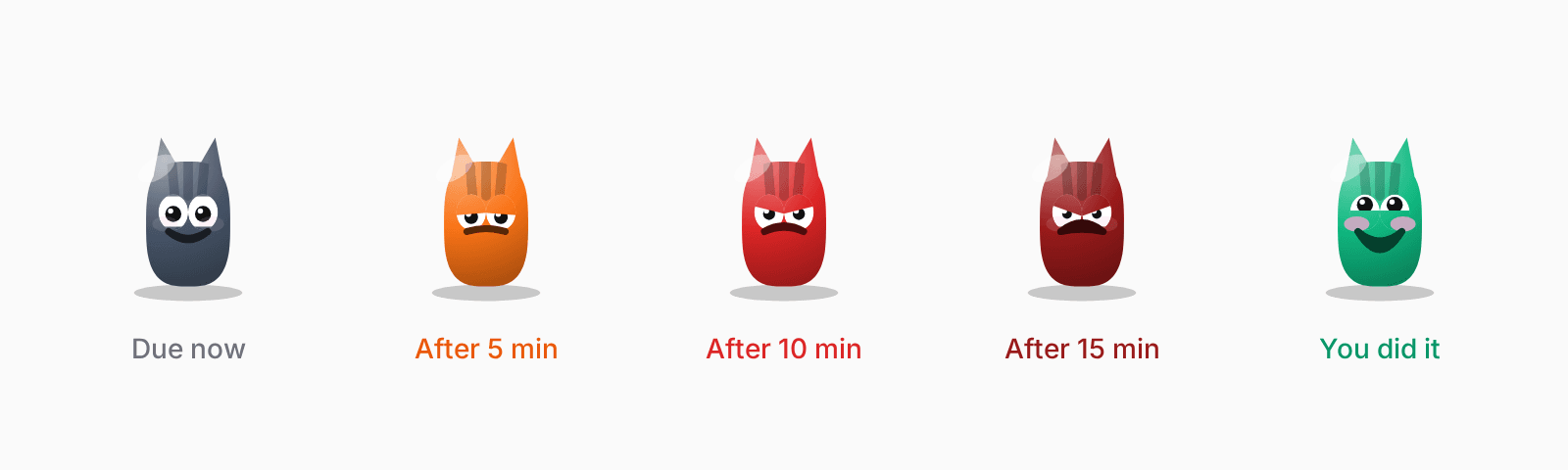
And because the colour is the mood, it tells you something new each time you look. Orange means "I have been waiting a while." Dark red means "it has been 15 minutes." That is a reason to look, which is the second thing the research found.
It will not stay new forever
To be honest: nothing stays new forever, and a face will not fix ADHD. There will be days you ignore it, even when it is furious. That is fine. It does not take away a streak. It just waits for the next time.
But a reminder that has a face, changes its mood, and looks back at you has a much better chance in week three than a grey box with the same words every morning.
Try it with the reminder you stopped seeing
Think of one reminder you close without reading. Turn it into a habit in Clarity, give it a time, and meet its face. (If you want the story of how the faces started, read The Angry Little Face That Fixed My Habits.)
Try Clarity free. Thirty-day trial, no credit card required.