One Missed Day Is Not a Lost Habit
Day 23. I had stretched every morning for 23 days, and the app said so in big orange numbers. Then I got sick for one day. The next morning the number said 0.
I did not stretch that morning. Or the next. I did not open the app again. Twenty-three good days, and one bad one was the end of all of them.
If you have ADHD, you may know this story from the inside. It is not the missed day that kills the habit. It is what you feel about it.
One slip, then "why bother"
Psychologists have a name for this. Alan Marlatt, who studied relapse, called it the abstinence violation effect: after one slip, you feel you have already failed, so you stop trying. One cookie breaks the diet, so you eat the whole box. One missed day breaks the streak, so you stop.
With ADHD, that feeling can hit harder. Strong emotions that are hard to manage are common in ADHD. A 2014 review by Shaw and colleagues found emotional dysregulation in a large share of adults with ADHD. Many people also describe a sharp pain at any sign of failure or criticism, sometimes called rejection sensitivity. It is not a formal diagnosis, but the feeling is real: one miss does not feel like one miss. It feels like proof.
One miss does almost nothing
Here is the good news. The habit itself does not care much about one day.
In 2010, Phillippa Lally and her team at University College London followed 96 people for 12 weeks as they built a new habit. For a typical person, a habit took about 66 days to become automatic, and for some much longer. They also found that missing one chance did not really change the result. The habit kept growing after the miss.
So the miss is small. The shame after it is the big part. And shame does not help you come back. In a 2012 study, Breines and Chen found that people who were kind to themselves after a failure tried harder to improve than people who were hard on themselves.
That means a good habit tool should do two things. It can push you today. But tomorrow, it must let you start again without a debt.
No streak to lose
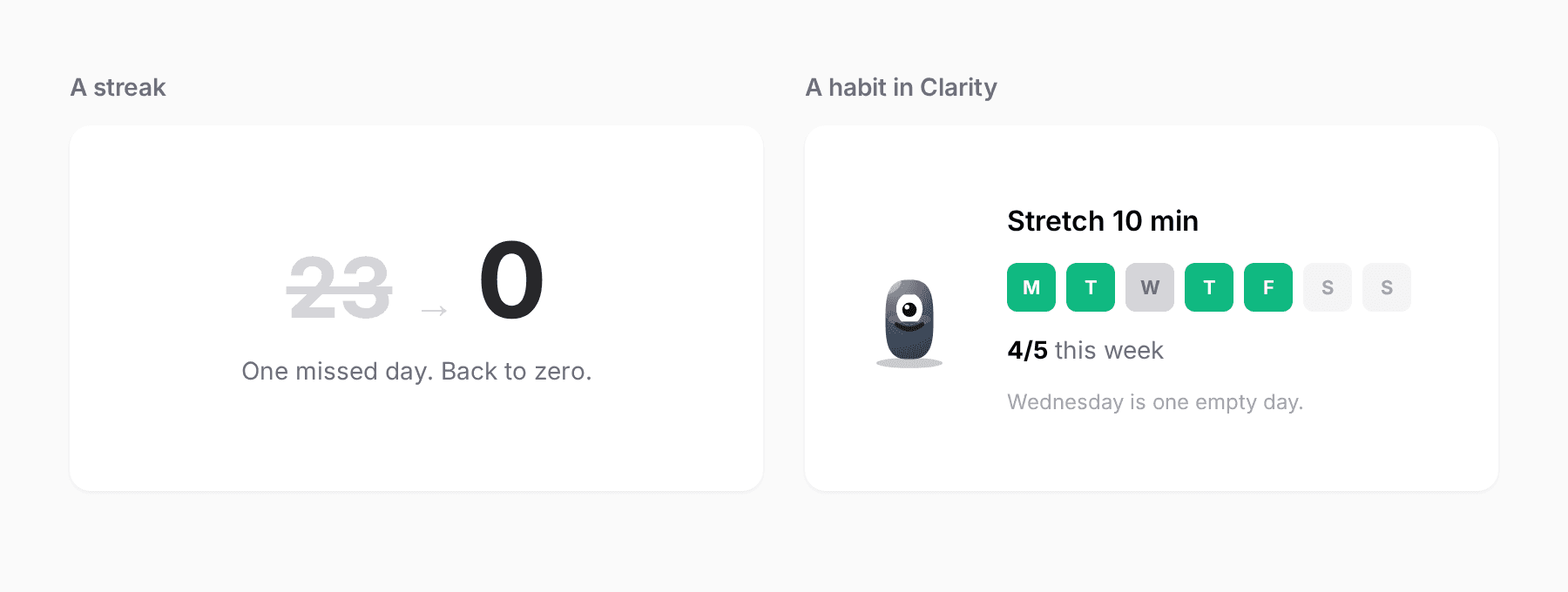
A streak does the opposite. It turns 23 good days into one number, and one bad day sets that number to zero. Your history is still real, but the screen says you have nothing.
A habit in Clarity does not count a streak. It counts days: how many days you did it this week, or this month, against the number you set. You can set 5 days a week instead of 7, so a missed day is already part of the plan. If you miss Wednesday, the week says 4 of 5. Wednesday is one empty day. Monday, Tuesday, Thursday and Friday are still there.
Angry today, calm tomorrow
The face is not soft. When a habit is due, its face comes to the corner of your screen and waits. Calm at first, then annoyed after 5 minutes, angry after 10, furious after 15. That push is the point. (The story of why a face works is in The Angry Little Face That Fixed My Habits.)
But its anger has an end, and the end comes soon:
- Skip now sends it away until the habit's next reminder.
- At midnight, every face leaves. A new day starts with no faces from yesterday.
- At the next reminder, it comes back calm. Its mood counts from that reminder, not from the day you missed. It does not remember.
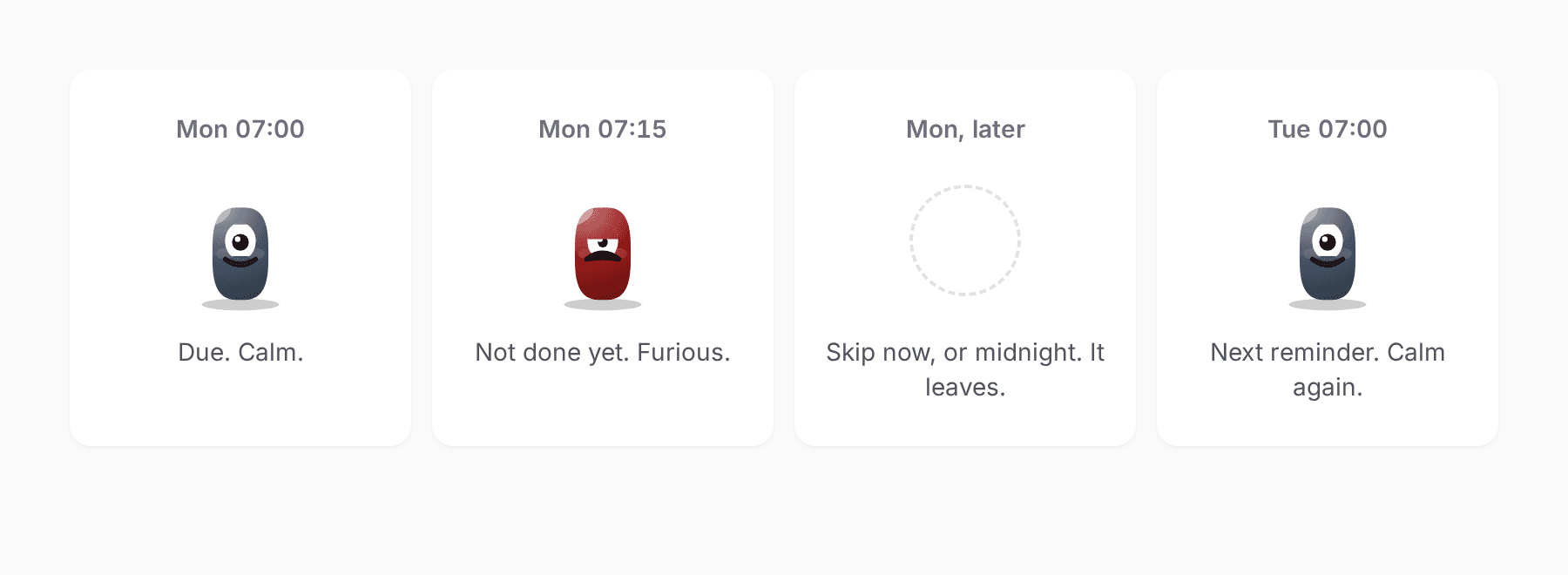
So the face is angry about now, not about you. That is a big difference for an ADHD brain. "You have not stretched yet this morning" is something you can fix in 10 minutes. "You broke your streak" is something you can never fix. Only the first one gets you up.
Clarity also never takes points away. A missed day costs no XP. You only earn when you do something.
What to do after a missed day
- Do not plan to make it up. Doing it twice tomorrow is a new debt. Just do the next one.
- Wait for the next reminder. The face will be calm. Meet it there.
- If you miss a lot, lower the number. Three days a week that you keep is better than seven that you keep missing. Open the habit and change its days per week.
Honest note
A face will not make shame go away. Some days you will still feel bad about a miss. But a tool should not add to it. A zero on the screen adds to it. A face that is calm again the next morning does not.
If you stopped a habit after one bad day, it is not too late. The 23 days still count. Try Clarity free. Thirty-day trial, no credit card required.