Not Sure What to Do? Start the Timer
It is 09:30. I have coffee, the laptop is open, and I have a free morning. Then the question comes: what should I do first?
The email I owe? The bug? The article? I open the list. I close it. I check one message, then another. I tidy the list a little, because that feels like work. At 10:15 I still have not started anything, and I feel worse than I did at 09:30.
If you have ADHD, you probably know this morning. Nothing is too hard. The hard part is the question.
Knowing is not the problem
Russell Barkley, one of the best-known ADHD researchers, puts it like this: ADHD is not a problem of knowing what to do. It is a problem of doing what you know. You know the email matters. You know the bug matters. The step that does not happen is the one from knowing to starting.
And "what should I do first?" makes that step bigger. Now you must compare five things, guess which one is most important, and feel bad about the four you did not pick. Every minute you spend on that question is a minute you did not spend on any of the five.
Ask a different question
So I stopped asking "what should I do?" on mornings like that. I ask a smaller question, one that already has an answer:
Did I do my focus sessions today?
Not "did I finish the important thing." Only: did I sit down and focus, as many times as I said I would. That I can answer with a number, and I can change the number by starting now.
This is close to what psychologists call an implementation intention: you decide the action before the moment comes, so in the moment there is nothing left to decide. Peter Gollwitzer studied these "if-then" plans for years, and work with children with ADHD (Gawrilow, Gollwitzer and Oettingen, 2011) found that they can help with self-control too. They are not a cure. But they take one decision away at the moment when deciding is hardest.
One number for every day
In Clarity, that number is your daily focus target. On the Things page, under the focus timer, tap the row of small blocks and pick how many sessions you want a day, from 1 to 16. The target is kept every day until you change it, so you set it once and do not think about it again.
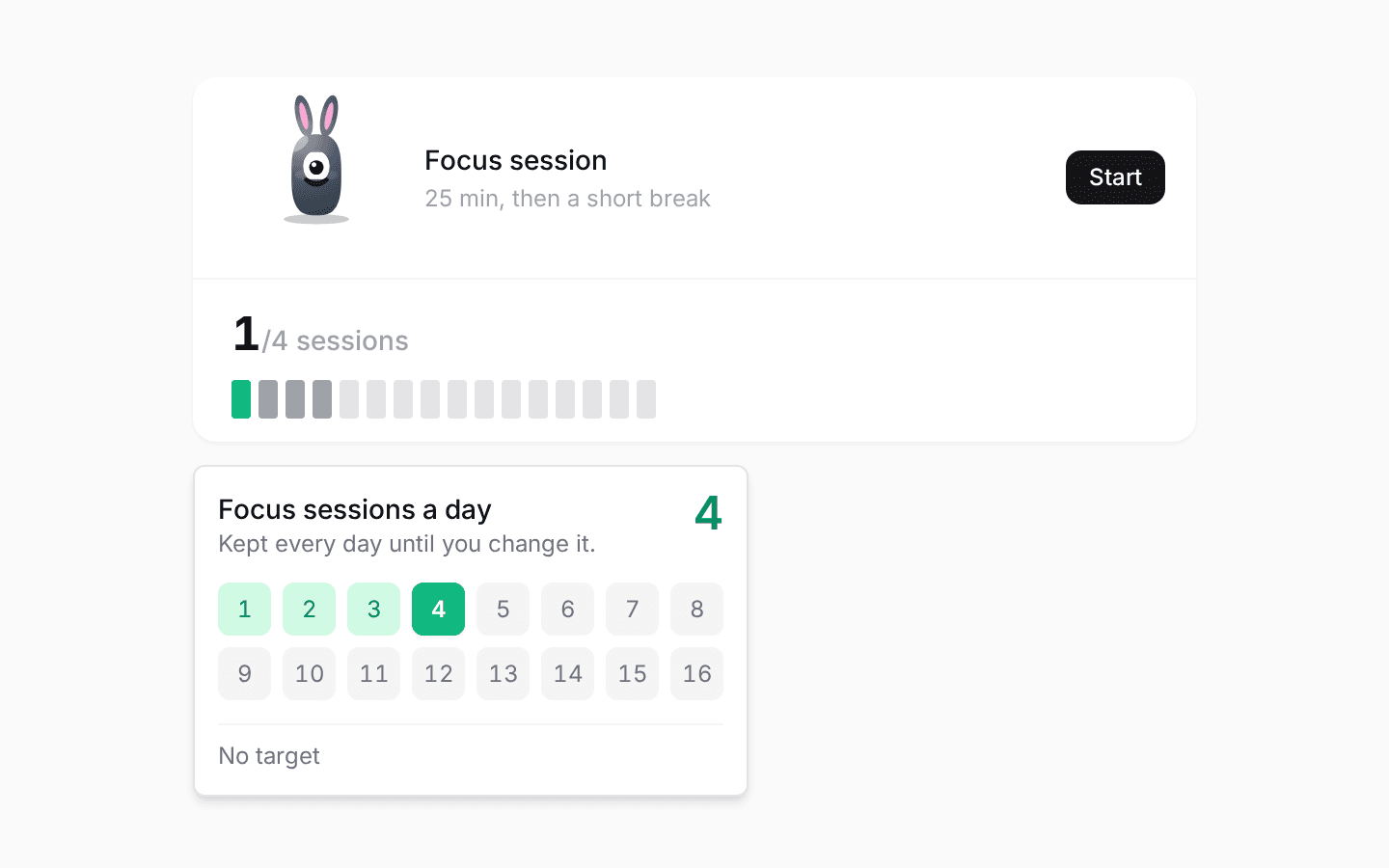
Pick a small number. Four sessions is less than two hours of focus, and on most days that is enough to move the things that matter. You can raise it later. A target you meet is worth more than a big one you miss.
The face keeps the pace
When you set a target, the timer gets a face. It is your focus face, the same one every day, and its mood is the pace of your day.
It wakes up at 06:00 and expects your sessions spread across the day until 21:00. If you keep up, it is calm. Fall a little behind and it gets annoyed, then angry, then furious. While a session runs it is busy, working along with you. When you meet the target, it turns green and proud.
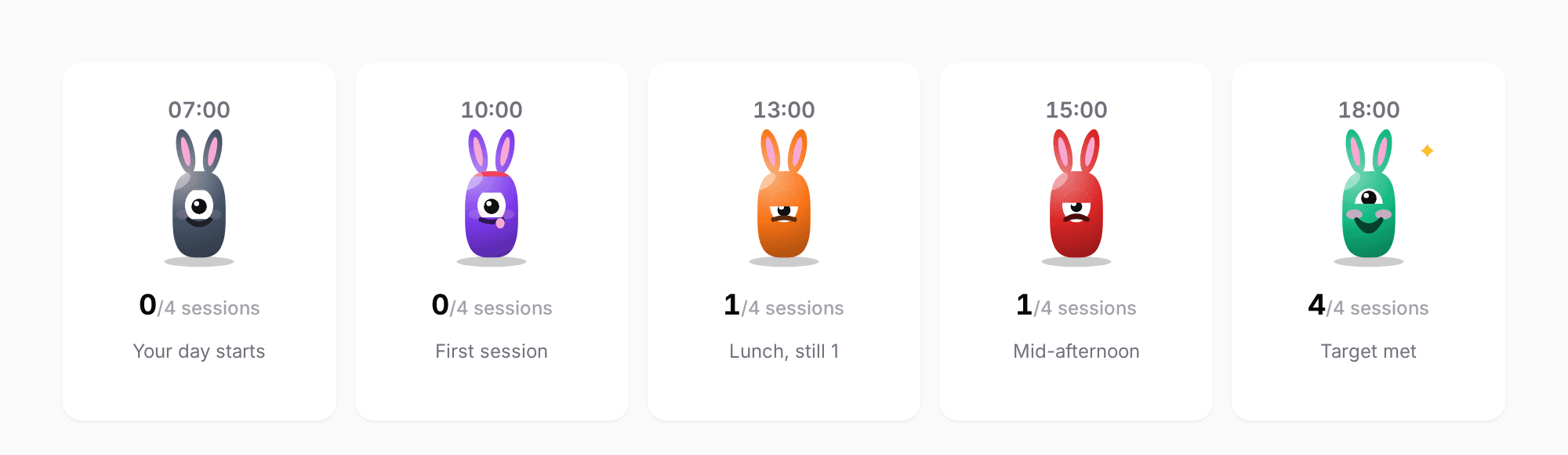
It also comes to find you. Until the target is met, the focus face sits with your other faces at the edge of the screen and shows how many sessions you have done, like "1/4 focus". Tap it and it takes you to the timer on Things. On a weekend, you can also tell it to skip today, and it sleeps until tomorrow.
Look at what the face does not ask. It does not ask which task you worked on. It only asks if you focused. That is the point.
Start 25 minutes first, choose second
So when I do not know what to do, I do not decide. I press Start.
The timer on Things runs 25 minutes, then offers a short break. It does not need a card or a task first. You can start it with an empty head. The question "what should I do?" is still there, but now it has a different size. You are not choosing for the whole morning anymore. You are choosing for the next 25 minutes, and the clock is already running.
That changes it. A choice for the whole morning feels like it must be right. A choice for 25 minutes only has to be good enough.
Then pick from two places
With the timer running, look in only two places:
- Things. Your short list. Every thing has a face, and a thing that has waited too long gets angry: annoyed after 2 days, angry after 5, furious after 10. The angriest face is a good first pick. It has waited the longest.
- A challenge you set. A number to reach by a date, like reading 20 pages a day this month. Its bar shows how much you did and how much of the time has passed. If you are behind, a session on it is never a wrong choice.
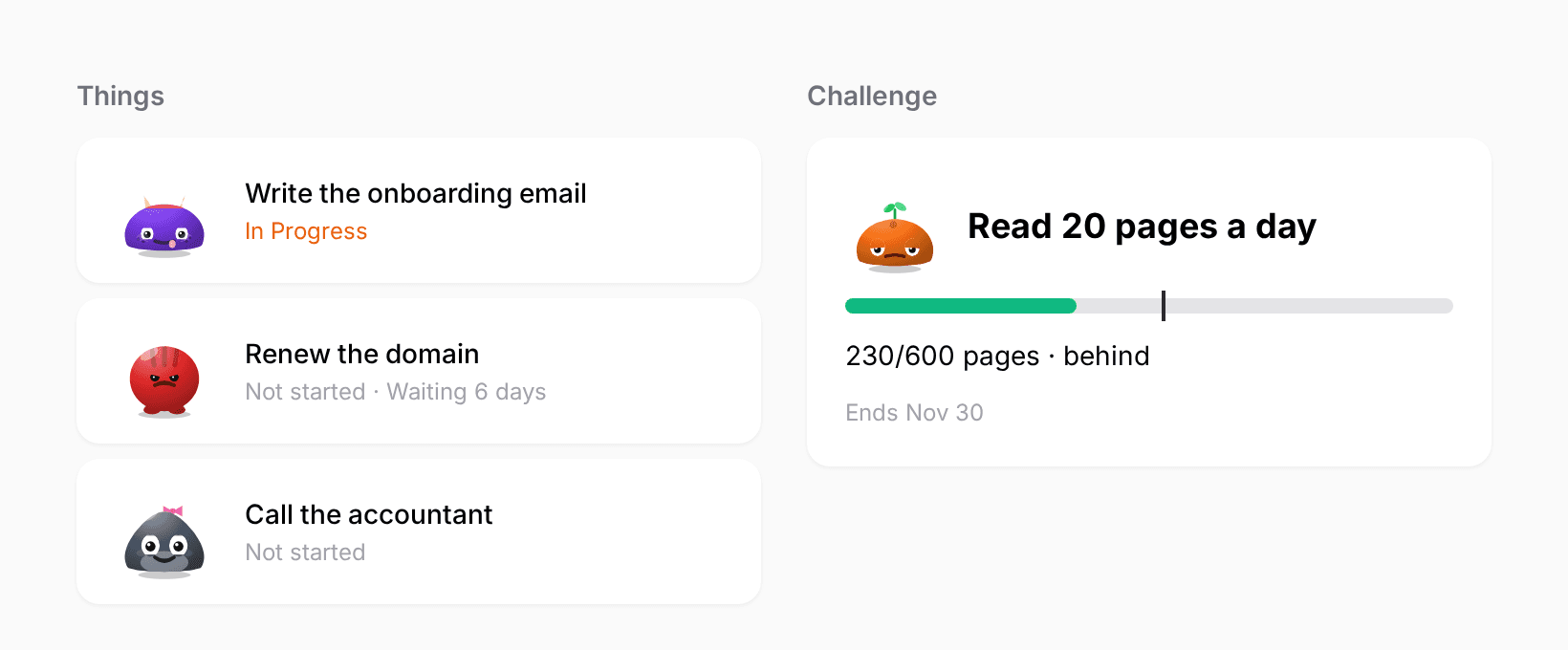
You chose these things before, on a calmer day. Things holds what you said you want to do now. A challenge holds what you said you want to reach. You do not need a new plan at 09:30. You need to pick one of the plans you already made.
And if you still cannot pick after a minute, take the thing at the top of Things and go. A session on the second-best thing is much better than no session.
When the target is met, you are done
This is the part I like most. When the face turns green, the day's focus is done. You do not need to find one more thing to do to feel OK. You can do more if you want, but the day already counts.
For an ADHD brain, that matters. Without an end line, the to-do list never stops, and the day always feels like it failed. A small number that you can meet gives you a day that can be finished.
Try it tomorrow morning
Set a daily focus target on Things. Start with 3 or 4. Tomorrow, when the "what should I do?" question comes, do not answer it. Press Start, then choose. (If you want to know why the focus timer sits on top of Things, read A Short List, Kept Until It Is Done.)
Try Clarity free. Thirty-day trial, no credit card required.